
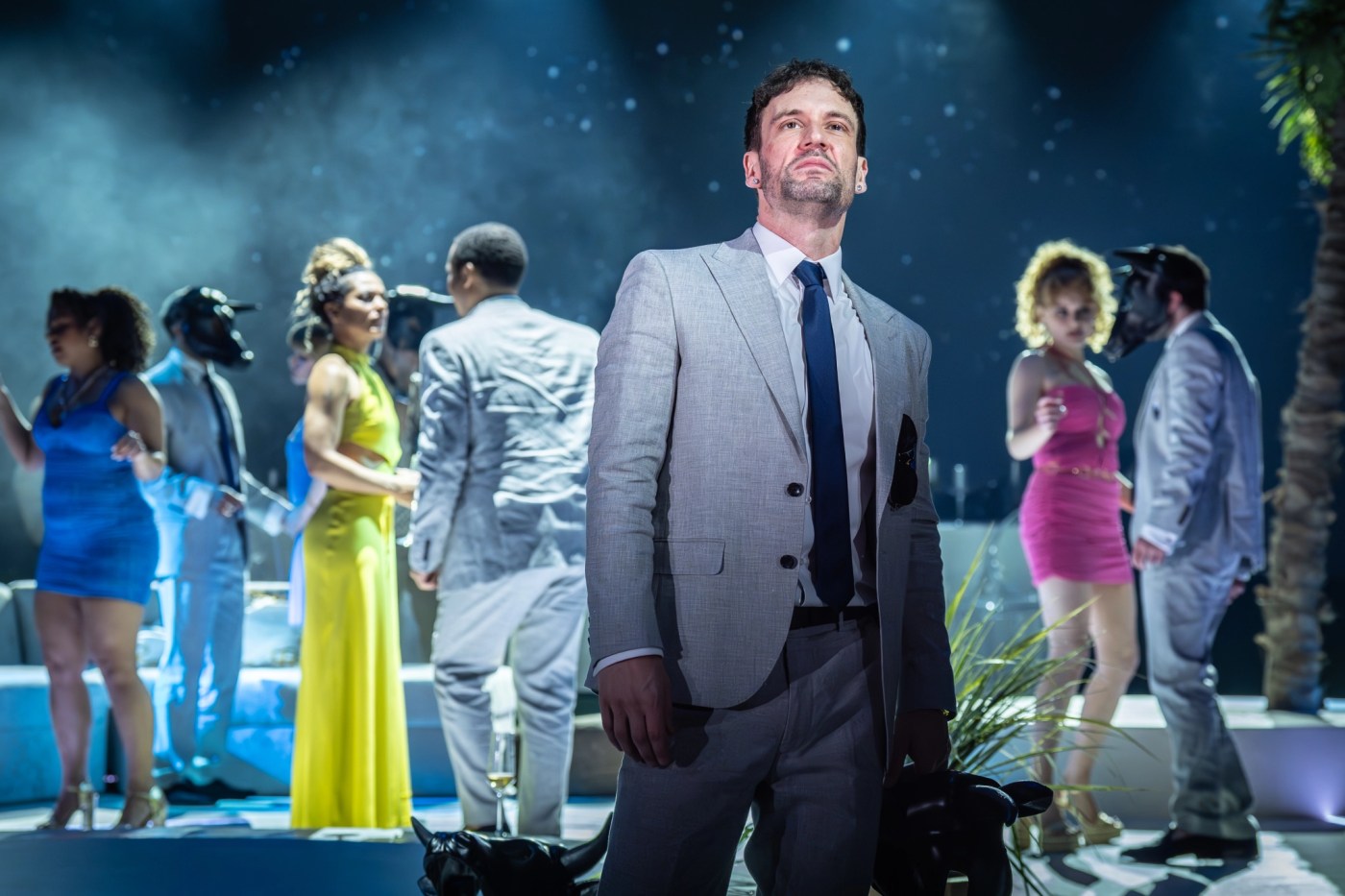
Vicky Holding reviews Much Ado About Nothing at the Royal Shakespeare Theatre, Stratford-Upon-Avon.
I would like to preface this review by saying that the last time I watched Much Ado was during the 2014 season, where Love’s Labours Lost and Love’s Labours Won played together in rep, directed by Christopher Luscombe. This quicky became my favourite production of the play, so it was a little tricky going into something so starkly different from the start.
With gaudy lights, a stadium tunnel setup and banners across the house, I initially thought “I’m going to hate this”. I didn’t know quite how far the football theme would go. In the minutes before the play, the theme developed further, with a growing intensity of football commentary and crowd noises playing out over the speakers and team portraits and stats on the screens. A nice touch.
And so, the play begins with a celebration. Instead of a battle they’ve been fighting – a cup match. Gone are references to wars, in are references to football (even “Signior Own-Goal”, Mountanto in the original words). The boys are rowdy, celebrating and followed by a stream of WAGs who wouldn’t be out of place in Love Island. Leonato, the owner of Messina FC, is supported by his wife Antonia (gender-swapped version of the original text’s Antonio, father of Hero).
The set is an ITV reality show’s wet dream – marble, plants, a huge dining table and an actual jacuzzi on stage (must be a nightmare!) – an impressive set piece and very well-used for Benedick’s hiding to overhear the lads’ constructed conversation about how Beatrice is in love with him. The bedroom dropping down from the ceiling was great, as was the transformation from stadium tunnel to house party. The costumes, outside of the football kits and coordinated Messina FC suits, are loud and brash, all sparkles and sequins, chinos and slip-on shoes.
I never thought I’d say this, but the use of screens and cameras was brilliantly claustrophobic and invasive, getting in their personal space and allowing no privacy. This carried through with the defaming of Hero using some clever photo editing as “evidence”, and the social media comments were a very good tongue-in-cheek touch.
All of the stuff around the action did feel like it gets in the way at times. Leafy plants, chairs and statues, the height of the jacuzzi, even some of the blocking of the cast along the walkways leaves quite a lot blocked in the way of sight lines. And it did mean that you’d have to have sat right in the middle for a “perfect” view.
Performances are overall very enjoyable, although with most of the action taking place upstage, not everyone quite had the volume or pacing for vocals to carry out across the auditorium. A clear stand-out for me was Nick Blood’s Benedick, the perfect blend of estuary cockiness and woeful clumsiness as he navigates his desire for Beatrice. He’s got a funny face and the delivery to go with it, very Chris Barrie’s Brittas at times, especially when hiding under massage tables and losing what little clothes he had on.
Freema Agyeman’s Beatrice is sassy and sharp (I’ve been a huge fan ever since her Doctor Who days) and I enjoyed the journey from her cutting start of the play football reporter to vulnerable and lovesick by the second act. Eleanor Worthington Cox’s Hero is sweet and naïve – a terribly written and underused character but she bolsters it with the incredible vocals she’s become famous for since her star turn in the West End’s Next to Normal last year.
I loved Daniel Adeosun’s Claudio (the man of the match) and Olivier Huband’s Don Pedro (the “prince” AKA club manager), who both had clear, perfect vocal clarity and played genuine performances, from upstanding honest men to those who had been wronged, to regretful. I wanted to hate them, but I couldn’t. Peter Forbes’ Leonato was gorgeously slimy and his My Way an absolute scene-stealer, and Tanya Frank’s Antonia defending her daughter gave me a proper lump in my throat.
Antonio Magro’s Dogberry was a Frank Spencer/Stath Lets Flats hybrid and very funny but I thought the watch’s scenes were over far too quickly – possibly because of the Luscombe version where they seemed to take up half the play. I also wish they’d made more of Nojan Khazai’s Don John – out of the game because of an injury, brooding and resentful – I would have liked this to have been even clearer, even though I know you can only do what you can do with the script. The supporting cast were all good and everyone worked well together as an ensemble.
I will say that it was definitely a play of two halves – as you expect – with the discovery of Hero’s “affair” being the cliffhanger act drop. The first half, karaoke, prosecco, parties and silliness; the second, stony faces and sobs interspersed with bursts of comedy. But hey, it’s the way Shakespeare intended, and it does all resolve itself in the end, though it could perhaps have had a little more celebration once everything was resolved. All in all, I still thoroughly enjoyed it, and it’s reminded me to leave my preconceptions at the door. Theatre is always surprising in that way.
Much Ado About Nothing plays at the Royal Shakespeare Theatre until the 24th of May.
 DownstageWrite
Leave a comment