
Tony Homer reviews “The Shark Is Broken” at Birmingham Rep, 8th May 2025
In 1975 Steven Spielberg directed the movie ‘Jaws’. Based on the novel by Peter Benchley it immediately broke all previous box office records and became a much loved and iconic film. However, it was not all plain sailing. The film exceeded its budget of $4 million not least because of problems with the mechanical sharks adding $3 million. It was also the first film to be shot on the ocean which added to the challenges of filming and with daily shoots often reduced to 4 hours instead of 12 hours, the three principle actors who set sail to kill the shark naturally went a bit stir crazy. Tensions particularly grew between Robert Shaw (Quint) and Richard Dreyfuss (Hooper).
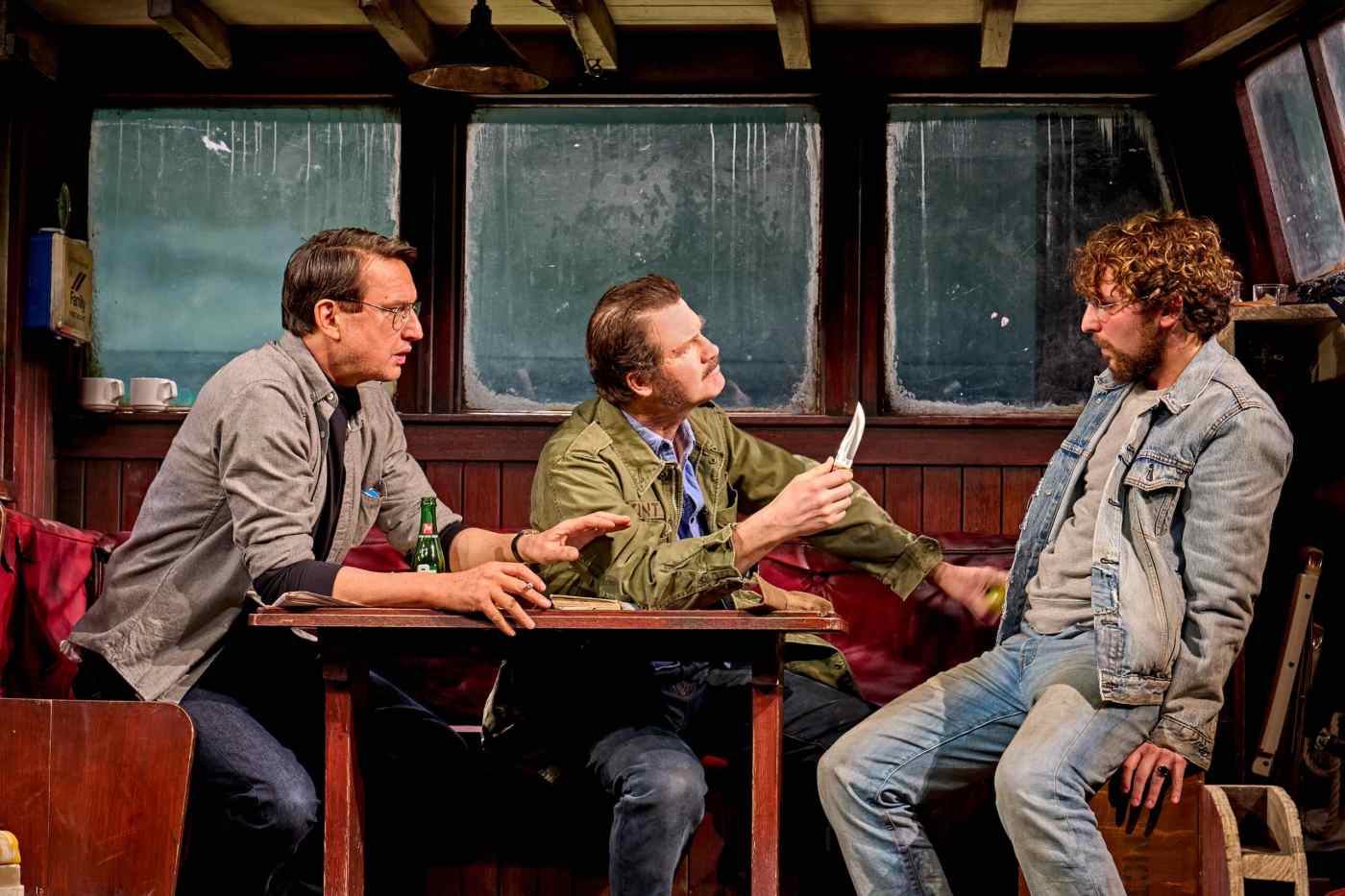
All of which provides perfect material (or shark bait) for this play which explores how the actors coped with being idle for such long periods whilst ‘Bruce’ the mechanical shark was repaired. The boat ‘Orca’ is our setting, the ever changing ocean our backdrop, the main cabin and foredeck our viewpoint. We are ‘on set’ and as soon as (Roy Scheider/Chief Brody) Dan Fredenburgh and (Richard Dreyfuss/Hooper) Ashley Margolis enter along the rear edge of the cabin I was immediately reminded of the film when the characters edge dangerously from one end of the boat to the other. Both actors bear uncanny resemblances to their namesakes and as the action proceeds they inhabit their parts with all the mannerisms and tics of those stars.
Mirroring the film somewhat we await the arrival of Quint played by Roberts Shaw’s son Ian, who has also co-written the piece with Joseph Nixon; the latter possessing an apt surname as the President of the day is heavily referenced by Scheider (from now on I will use the film actors names) as he continually reads the daily newspaper. At one point Shaw/Shaw (!) suggests that they will never experience a worse or more vain President, which resonates with the audience who are treated to laughs throughout the play. For it is the humour of the situation which is most evident, interspersed with discussions about fame, fathers and the future. “Do you really think they’re gonna be talking about this film in 50 years?”
And when discussing the young Speilberg, Dreyfuss admits he is considering the lead role in ‘Close Encounters of The Third Kind’, at which Shaw bemoans the idea of films about aliens and the probability of ones about dinosaurs. In order to alleviate the boredom the three play cards and at Shaw’s behest shove ha’penny. His competitive streak is shown when he suggests a minimum wager of $100, and further allusions to his tax returns give an insight to his financial situation. He has 9 children to support for starters (“you’re gonna need a bigger boat” quips Scheider!) and something of a drink problem.
In exposing some of the truths about his father, Ian Shaw provides a picture of a man who loves his adopted country of Ireland, the distress of losing his own father when only 12 years old (he hoped to grow older than his father who took his own life aged 52 but sadly Shaw dies 9 years after the film only 51) and his passion for acting, particularly Shakespeare. Dreyfuss craves fame and fortune and opportunities to play Shakespeare but is already on the path to drug abuse. And yet he is the one who berates Shaw for his drinking. Scheider we learn was a boxer in his youth but acts as the peacemaker on more than one occasion when the other two come to verbal and physical blows. Fans of the film (which surely accounted for 99.9% of the audience) are not left wanting for nods to the movie be they memorable moments such as the sea shanty ‘Spanish Ladies’, to the more subtle when Dreyfuss crushes a paper water cup. If you know, you know.
And so to the finale, the final shoot, the speech by Shaw about the sinking of the USS Indianapolis. The intimacy of the scene and the delivery of the dialogue is as close to the original as it might be possible, lent added bravura as it’s delivered by his son. Earlier, the three actors have been discussing what the film is all about. Dreyfuss supports the psychological; Scheider the contemporary political relevance; Shaw profoundly declares it’s about a shark. Well I can assure you this play is about three memorable performances from three very fine actors and the legacy of one brilliant film.
 DownstageWrite
Leave a comment